
Affiliate Ad Disclosure: We’re reader-supported. When you buy via our links, we earn commissions. Learn more.
These 5 foods changed my view of Chinese cuisine


While living in China for over 3 years, I had the opportunity to try a variety of different authentic Chinese cuisines. Growing up, I was quite the picky eater, but, after moving to China, I decided to adopt the mindset that many things outside my comfort zone are worth trying (at least once).
I’ve previously explained why I think more Americans should visit China. But one thing I didn’t cover was how visiting China can be an adventure for foodies. In this piece, I’d like to take a moment to introduce you to some authentic Chinese foods that I tried while living in China.
Some of these dishes have become staples in my foodie life, and many of them have shown me how much the Chinese value communal time with friends and family with food.
Hot Pot (火锅 / huǒguō)
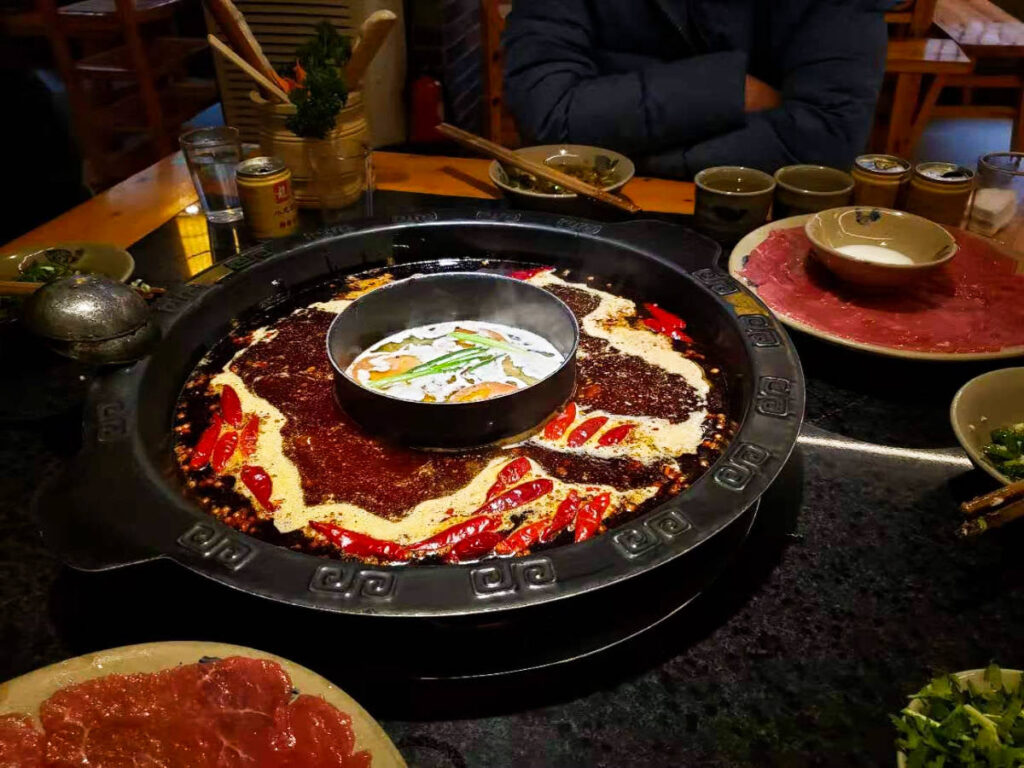
Hot pot is popular all across China. This popular cuisine – or rather experience – has been around for about two thousand years. It is said that hot pot originated from Mongolian horseman, but you can find it all over China now.
From spicy to herbal, hot pot comes in a variety of flavors and styles. But the concept is typically the same. You select a broth, order a bunch of uncooked dishes, and whip up a dipping sauce (varies regionally).
Many restaurants have divider pots so that you can order two flavors. Then you can throw the uncooked food in the pot and wait for it to cook in the boiling broth. This results in a very social meal, which makes it a popular choice on the weekend with friends or family.
There was one particular style that stole my heart – or rather my taste buds – and that is spicy hot pot. Specifically, Sichuan and Chongqing hot pot. These broths, which are often beef oil, are bursting with spices. The most notable spice is mala, which is a spicy and numbing flavor.
Hot pot is one of the first cuisines that showed me how important community is in Chinese culture. Most meals, especially during special celebrations, are typically shared meals around a round table.
Interesting Info: Hot pot is a symbol of unity in Chinese culture, which is represented by the circular pot and the custom of sharing food together.
Noodles (面 / miàn)
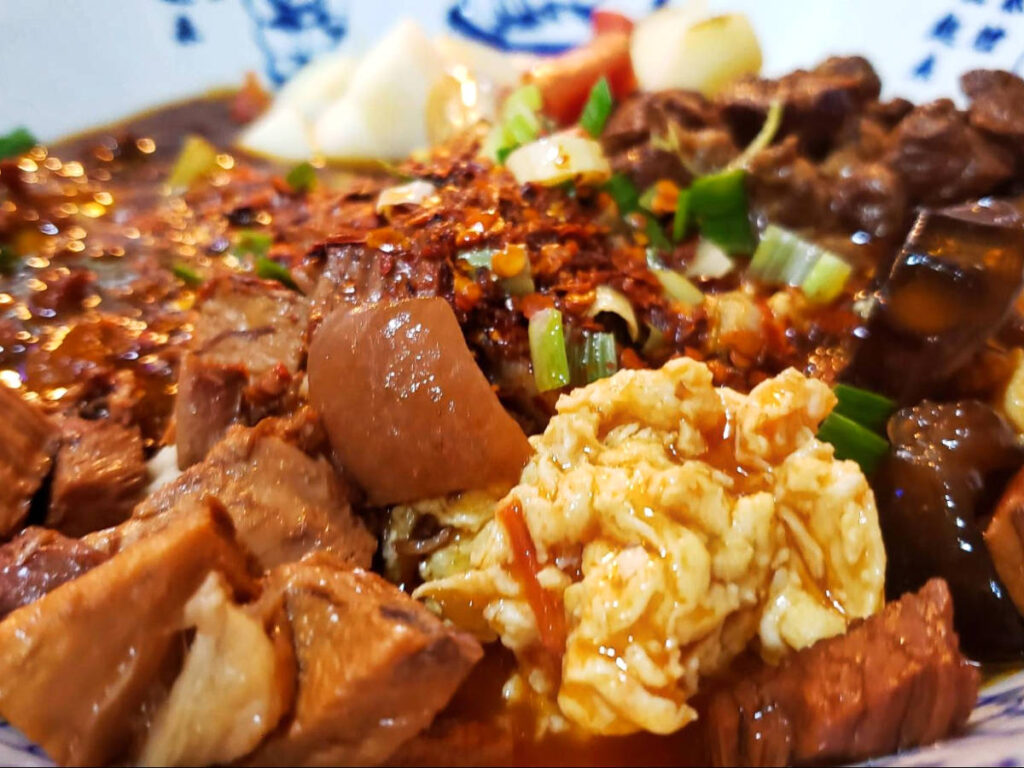
Noodles are a staple in Chinese cuisine. Prior to moving to China, my knowledge of Chinese food consisted of Americanized food, so, when I thought of Chinese noodles, it was typically lo mein.
While I still enjoy a bowl of lo mein from time to time, there is something truly captivating about China’s noodle culture.
The flavors and styles change drastically depending on what region of the country you visit. But, one thing is certain, you’ll see a variety of noodle shops.
Noodle shops are often fly, or hole-in-the-wall, restaurants with run-down decor and an open wall concept at the front. Oftentimes, you’ll see streets lined with people sitting on small chairs grubbing on a bowl of noodles. You’ll also find noodle shops in the most random places, including street vendors.
It’s impossible for me to select my favorite noodle, but my most memorable noodle experience took place in Xi’an, which is home to biang biang mian. The noodles for this dish are hand-pulled and known for being thick and chewy.
While on a trip to Xi’an we met a cook who had been making Biang Biang Mian for 40 years. He was very proud of his skill and invited us back to his kitchen so that we could watch him form the noodles from the dough, which created a loud “biang” sound. This experience gave me a front row seat to the passion that goes into creating Chinese cuisine.
Interesting Info: On birthdays, many restaurants will give a bowl of noodles instead of dessert to symbolize longevity.
Chinese BBQ Skewers (燒烤 / shāokǎo)

As with the other foods I’ve mentioned, Chinese BBQ comes in a variety of forms and flavors. One particular style is shao kao, which is heavily spiced food on skewers. The skewers are seasoned with cumin, Chinese five-spice powder, and other spices.
Shao kao can be found at both restaurants and on the streets. You’ll find more of a variety at restaurants, since they typically also offer side dishes. Some examples of dishes include clams, oysters, scallops, eggplant, and a variety of other flavor-packed items.
The street vendor shao kao usually only offers skewers. Since many Chinese cities are lively at all hours of the day, the shao kao vendors will usually come out at night. You’ll certainly see them near bar streets, since these tasty skewers make an excellent snack after a night out.
While living in China, my husband and I loved to walk the busy streets of Chengdu at night. On the weekends, we’d often go to some of the busiest districts to eat and explore. We’d grab a beer, order some shao kao, and eat on small, plastic chairs that seemed more suitable for children due to their size.
One thing that I really love about shao kao is that you get to select the quantity of the specific items that you order. At the street vendors, you typically grab a basket and fill it with the skewers that you want. This system allows you to try a variety of different meats and veggies.
Interesting Info: Chinese BBQ, like many Chinese foods, is often a social thing. At night, especially in the summer, it is common to see groups of people eating skewers, drinking beer, and sitting on plastic stools in the busy streets. Some locations can get pretty rowdy.
Family Style Dishes (家常菜 / jiāchángcài)

Prior to moving to China, my idea of eating out was typically getting a personal dish and maybe an appetizer. So, upon arriving in Beijing, I was in awe the first time I experienced a true Chinese family style meal.
At family style meals, you (or typically the host) selects numerous dishes to share with the table. Many of these dishes are often similar to what is cooked at home in the particular region. The table usually has a lazy susan so you can easily spin it around and try all of the different dishes.
At special events, the plates are often stacked until the table is overflowing with food. There were many times, especially at important events like weddings and work events, when I thought the plates would slide off the table!
Family style meals reflect the communal aspect that is important in Chinese culture. While living in China, I learned that the Chinese often use food to show that they care about you. Whether it is sharing a meal out together or having you over for a feast, food is a serious part of the culture.
One of the most common greetings is even, “Have you eaten yet?” While this saying can also be used casually, it represents how important food is to the Chinese. Another saying you hear often is, “Are you full?” as the host offers more and more food (even if you are full!).
Interesting Info: At family gatherings at restaurants, it is customary for the guest of honor to sit facing the door/entrance. At important meals, there should be leftovers.
🌈 Read Next: My Visit to China’s “Rainbow Mountains”
Grilled Fish (烤鱼 / kǎoyú)

Fish is an important part of Chinese cuisine. There are a wide-variety of fish dishes that vary from region to region, but kao yu is the specific dish that stood out to me. Kao yu can be ordered in a variety of flavors, but it is typically served in a big pan over a gas burner.
I’ve got a soft spot for spicy food, so I instantly fell in love with the flavors of Chongqing’s spicy kao yu. The first time I tried this dish was on one of the first dates I had with my now husband. He took me to an old part of Chengdu to a place that looked like a hole in the wall.
It was a cold evening, but we were sitting outside next to a lively street. The streets of Chengdu give off an energy that makes you want to be a part of it, which makes it common to sit outside year round.
As the server delivered the dish, I was shocked to see a whole, steaming fish with a variety of different veggies and spices. They placed it on a gas burner so it would stay warm and the flavors could continue marinating.
And, like many of the other cuisines I’ve mentioned, this meal is communal. So the whole table shares the kao yu. It is also common to order other side dishes with it, which can quickly turn the meal into an evening of sharing food and socializing.
Interesting Info: Fish symbolize wealth in China. During the Lunar New Year, it is customary to eat a whole fish to bring prosperity in the new year.
👉 Read Next: 5 things to know before you travel to China
***
China is a country of foodies that take both the food and the communal aspect of eating very seriously. I spent most of my time in the Sichuan province of China, but, no matter where you go in the country, you’ll find that meal time is usually a big ordeal when planned with family, friends, or colleagues.
In addition, you’ll find that the preparation and work that goes into cooking the cuisines, even common dishes like noodles, are taken very seriously. After learning more about the true complexities of most Chinese cuisines, I’ve gained an appreciation for the work that goes into each individual dish.
The communal experience and complexity of the different cuisines are something I valued the most about my time in China. Whether it was with friends or family, meals were something that were cherished and savored.
If you’re ever invited to a meal in China, I can certainly guarantee you won’t leave hungry!
More Latest PERSPECTIVES


And now I am salivating!! So much good food and rich history in the dishes.
I really enjoyed your comments about food? How did the people react to Americans? You hear so many negative things, it is wonderful to hear positive things. I appreciate it. Thank you.